C25/30 concrete: turn a common class into a complete specification
C25/30 is frequently encountered in structural work, but familiarity can create a false sense that the mixture is obvious. The class defines strength; the project still has to define durability, consistency, constituents, placing conditions and verification.
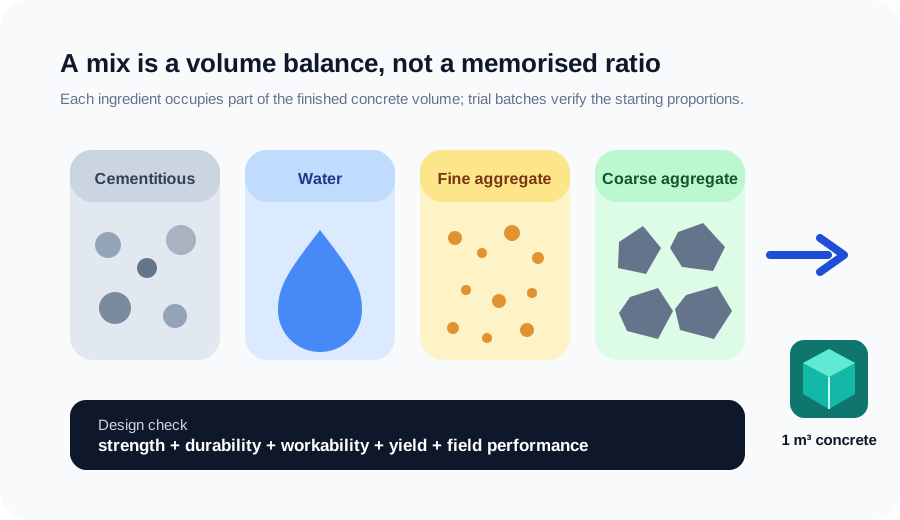
Why “standard C25/30” is not enough information
The class notation identifies characteristic cylinder and cube strengths, but it says nothing by itself about the required consistency, exposure classes, cement or combination, aggregate size, chloride restrictions, air content, intended life or placing route. Those decisions can materially alter the proportions.
A ready-mixed producer may have several C25/30 mixtures for different applications: pumpable concrete, low-slump concrete, exposed external concrete or mixtures using different binder combinations. Calling all of them “the C25/30 mix” hides the choices that actually control performance.
Workability is often the practical design challenge
For slabs, walls, beams or congested reinforcement, the required consistency and the way concrete reaches the formwork can matter as much as the nominal strength. Increasing water is the easiest way to make a trial more fluid, but it also changes the effective w/c. A better response may be a suitable admixture, a grading adjustment or a revised paste volume.
If pumping is intended, assess whether the sand fraction and mortar volume provide enough lubrication for the line while keeping the mixture cohesive. A calculator can show the mass balance; a trial reveals whether the chosen aggregate system actually moves and finishes well.
Moisture can overturn an otherwise good calculation
Fine aggregate moisture is especially important because a small percentage change can contribute meaningful free water. If the design is based on SSD quantities but the stockpile is wet, batching the nominal water unchanged raises the real free-water content. The result can be higher slump, more bleeding and a weaker or less durable paste than intended.
Record aggregate moisture at the time of the trial and correct both aggregate mass and added water. That habit is more valuable than adding another decimal place to a theoretical mix ratio.
A C25/30 trial should answer specific questions
- Does the mixture reach the specified consistency without uncontrolled site water?
- Is it cohesive enough for the selected placing method and reinforcement arrangement?
- Does the measured density indicate the expected yield?
- Are air content and finishability appropriate where they are project requirements?
- Does the strength development support the project's acceptance criteria with adequate margin?
- Can the producer reproduce the same result as stockpile moisture and temperature change?
When a higher class is not the right fix
If C25/30 is difficult to make durable or workable, simply changing the drawing to C30/37 is not automatically the solution. A higher strength class can increase binder demand while leaving the real cause—poor grading, excessive water demand, unsuitable admixture response or wrong consistency—untouched. Diagnose the controlling requirement first.
Likewise, if durability already imposes a verified w/c lower than the strength calculation would require, the mixture may naturally achieve strength above the nominal class. That does not mean the durability requirement was unnecessary; it means the environment governed the composition.