Estimate the first trial water—then let the materials correct you.
There is no trustworthy universal “kg of water per cubic metre” for a given strength class. Fresh-concrete water demand depends on aggregate surface area and shape, grading, fines, paste volume, consistence, admixture response, temperature and the placing method. A calculation can establish a starting point; the trial establishes whether it was right.
Free water is a fresh-concrete design variable
Free water is the water available in the fresh mixture after accounting for the chosen aggregate moisture basis. It contributes to lubrication and the effective water-cement ratio. That makes it different from simply reading the amount of water discharged from the plant tank.
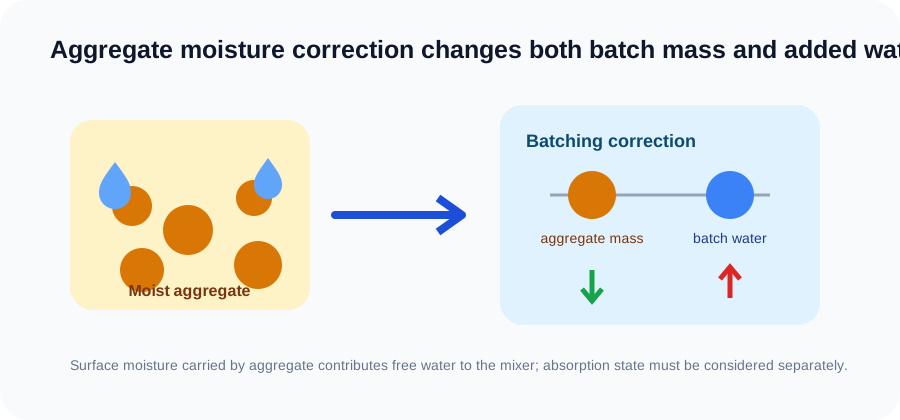
If wet sand brings additional surface water into the mixer, that water is part of the free-water balance even though it did not come from the water meter.
What usually pushes water demand up or down
| Variable | Typical influence | Why |
|---|---|---|
| Larger maximum aggregate size | Can reduce water demand | Less total aggregate surface area for a comparable grading/system |
| Rounded aggregate | Can reduce water demand | Lower inter-particle friction than angular crushed particles |
| Angular/rough aggregate | Can increase water demand | Higher friction and surface area |
| Higher consistence | Often requires more water or better admixture response | More particle mobility is required |
| More fines / high surface area | Can increase water demand | More surface must be wetted and lubricated |
| Effective water reducer | Can reduce required water | Disperses cementitious particles and improves flow at lower water |
| Poor grading | Can increase paste/water demand | Particle packing becomes less efficient |
How this calculator estimates a starting value
The calculator uses a transparent internal starting-water model based on maximum aggregate size, aggregate shape and consistence, then applies the water-reduction percentage you enter for the selected admixture. Those base figures are model assumptions; they are not presented as an EN 206 water-demand table.
That distinction is important. EN 206 provides the concrete specification/production framework. Actual water demand is established with the real constituent combination and production experience.
Use the first trial diagnostically
| Trial observation | Do not immediately assume | Investigate |
|---|---|---|
| Too stiff / poor mobility | “Add water” | Admixture dose/compatibility, grading, fines, paste volume, temperature |
| Bleeding | “Needs more cement” | Water content, fines, grading, air, admixture response and setting behaviour |
| Segregation | “Slump is too high” | Cohesion, paste volume, grading, discharge/handling and water |
| Sticky / difficult finishing | “Water is too low” | Fines, cementitious composition, sand fraction, admixture and air |
| Good slump but poor retention | “Initial water was wrong” | Admixture retention, temperature, transport time and cement compatibility |
Then correct for stockpile moisture
A trial calculation is usually easiest to understand on a defined aggregate moisture basis. Production quantities must reflect the actual condition of the aggregates. Wet aggregate contributes surface water; dry aggregate may absorb water. Measure current moisture often enough for the variability of the stockpile.
Frequently asked questions
Does EN 206 give one water-content table for mix design?
Do not treat it that way. The applicable standard framework controls requirements, but the practical water demand of a mixture is material- and production-dependent.
Does more water always improve workability?
It can increase fluidity, but it also changes w/c and can increase bleeding and segregation. If additional mobility is required, investigate the complete mixture and admixture system rather than treating water as a harmless adjustment.
Should admixture water reduction be entered at the brochure maximum?
No. Use evidence for the actual cementitious system, dosage, temperature and target retention. The calculator intentionally makes the percentage visible so it can be challenged.