What EN 206 does—and what the calculator adds
EN 206 is a concrete specification, performance, production and conformity framework. It is not a single universal recipe that converts C30/37 into kilograms of cement, water, sand and stone. The calculator on this site adds an educational proportioning model so you can explore a plausible starting mixture while keeping the standard and the calculation method conceptually separate.
1. Start with the concrete that is actually specified
Before proportioning anything, identify the required strength class, exposure classes, consistence, maximum aggregate size, chloride class and any additional project requirements. These are not interchangeable. A C30/37 strength class does not by itself establish durability, workability or constituent quantities.
For a real project, the relevant national implementation and complementary provisions must be identified as well. Requirements can differ between countries even when the European framework is shared.
2. Separate mandatory limits from design assumptions
The calculator asks for or displays durability-related limits so that they remain visible during preliminary proportioning. Those limits must come from the current rules applicable to the project—not from a generic European lookup table treated as universally binding.
Important: a maximum w/c, minimum binder content, air requirement or permitted constituent combination may depend on national provisions, the specified exposure, the binder system and the contract documents. Verify the controlling source before using a value.
3. Establish a strength target from production evidence
A preliminary mixture normally needs a mean strength target above the specified characteristic strength so that normal production variability does not create excessive low results. There is no responsible universal “add 8 MPa” rule for every producer and project. The margin should be based on the applicable acceptance framework and credible production or trial data.
Where adequate historical data do not exist, follow the procedure required by the governing national/project rules rather than inventing a statistical margin.
4. Select a starting water and binder balance
Workability, aggregate grading and shape, admixture system, temperature, transport and placing method all influence the water demand of fresh concrete. The site therefore treats water content as a starting estimate to be tested—not a value prescribed by EN 206.
Once a verified maximum w/c and a realistic starting water demand are available, a preliminary binder quantity can be calculated and checked against applicable composition limits. The selected binder system may also change how equivalence or additions are treated, so a simple cement-only division is not automatically a compliance calculation.
5. Close the volume balance
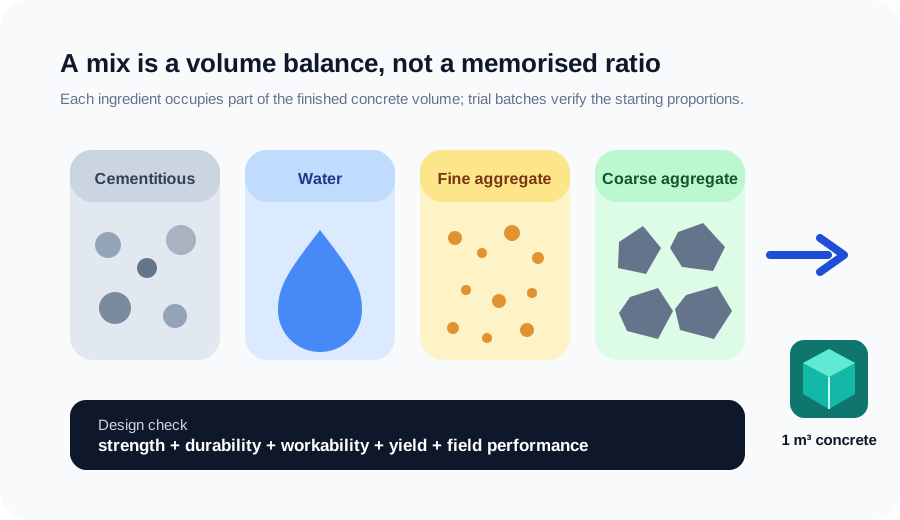
The calculator uses an absolute-volume balance to allocate the remaining concrete volume to fine and coarse aggregate after accounting for water, binder, air and other constituents. This is a useful engineering bookkeeping method: the constituent absolute volumes should add to approximately one cubic metre of concrete.
6. Correct the batch for actual moisture
Laboratory proportions are commonly stated on a defined aggregate moisture basis. Production aggregates rarely stay at that exact condition. Surface moisture contributes water to the mixer, while absorption affects how aggregate exchanges water with the paste.
Measure current moisture and correct both aggregate batch masses and added water. Otherwise the effective free-water content can move away from the intended value even though the printed mix sheet has not changed.
7. Trial, measure and adjust
A useful trial does more than crush cubes or cylinders. Check fresh consistency, density/yield, air where relevant, cohesion and segregation resistance, finishing/placing behaviour and the required hardened properties. Record each adjustment and its reason.
If the mixture is too harsh, do not automatically add water. Consider aggregate grading, paste volume and admixture response. If strength is high but the mix is difficult to place, the objective is not simply to keep reducing w/c. The mixture must meet the complete specification and be practical to produce and place.
What EN 206-1:2026 changes for this site
The 2026 generation reinforces why this separation matters. EN 206-1:2026 deals with performance, requirements, factory production control and assessment criteria; the project’s national implementation still determines how it is applied locally. Our calculator remains a transparent preliminary-model tool, not an automated conformity declaration.
A practical workflow
| Stage | Question | Evidence to keep |
|---|---|---|
| Specification | What concrete is actually required? | Project specification, exposure, class, consistence, constituent restrictions |
| Preliminary design | What starting quantities are technically plausible? | Assumptions, material properties, calculation trail |
| Trial | Does the actual combination behave as intended? | Fresh properties, yield, strength and other required test results |
| Production | Can it be reproduced consistently? | Moisture corrections, batching records, production-control results |
| Acceptance | Does it satisfy the specified conformity/acceptance process? | Required project and national records |